

When Fashion Revives Thinness, Who Pays the Price?
Fashion likes to think of itself as progressive. It likes the language of reinvention: rebirth, revival, reinterpretation, and with a constant insistence on being modern or even ‘ahead of the curve’. It is true that fashion’s genius lies in invention; however, we also see it in repetition. It is an industry built on return, hemlines rising and falling, silhouettes narrowing and widening, entire decades exhumed and rebranded as fresh. And when what returns is not merely a trend but a body ideal, the stakes become far more serious than whether a jean cut feels current. Take Dior’s bar jacket, for example: constantly reinterpreted and modernised, yet still there, everlasting and standing the test of time.
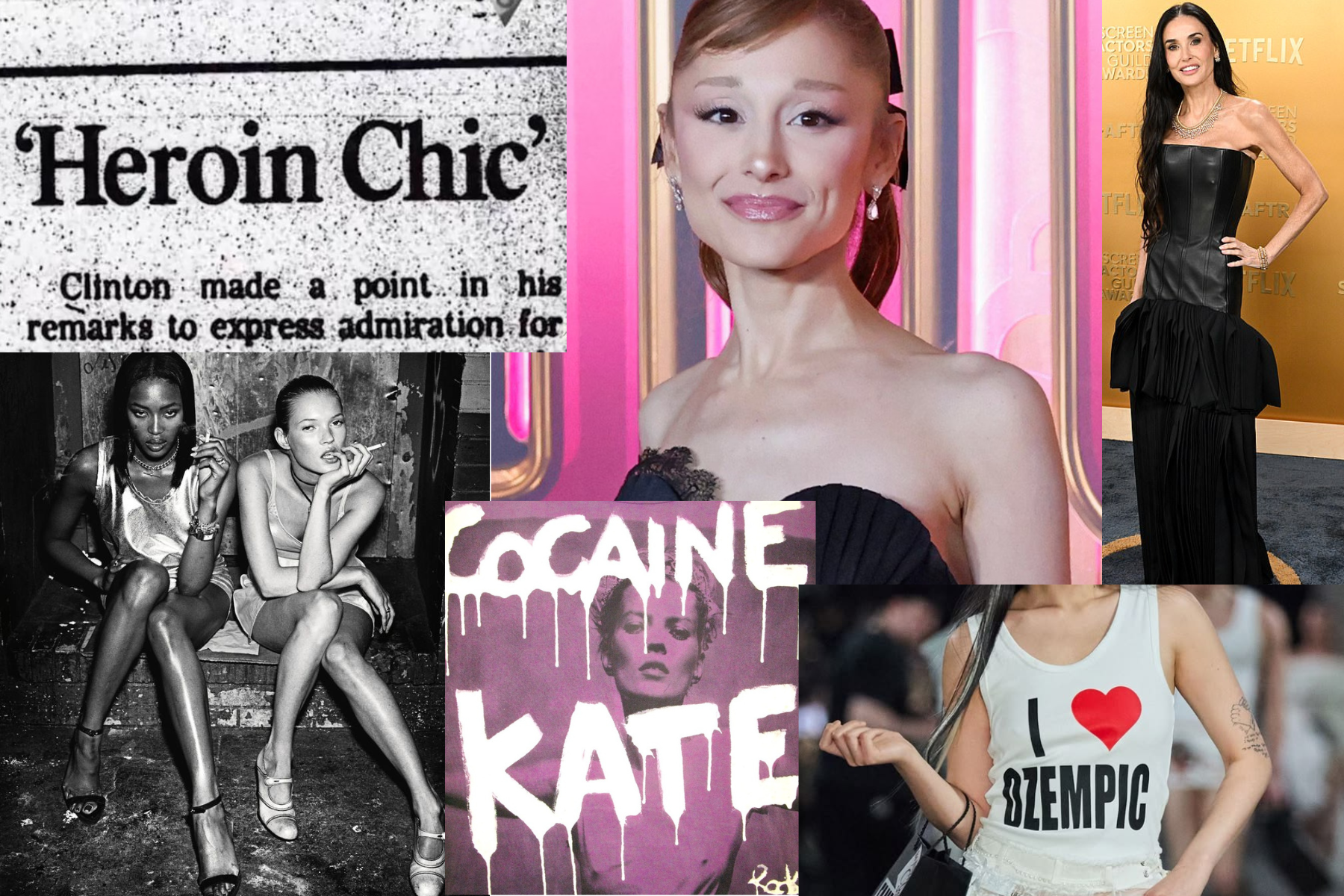
That is what makes the return of skinny fashion, skinny jeans, shrunken silhouettes, hyper-controlled bodies, and the ever prominent re-glamorisation of thinness, so culturally charged. It is about the revival of an old visual hierarchy in a new costume. It is about fashion’s recurring tendency to frame thinness as sophistication and elegance, and that bodily minimisation is a sign of taste. The silhouette may be different from the spray-on skinnies of 2010, but the cultural message is uncomfortably familiar. Trends go in. Trends go out. And yet the politics beneath them have a nasty habit of lingering.
The Runway Has Already Decided: Skinny Is Back
Before the average woman feels a trend in the dressing room, fashion houses have already editorialised it. Not to put fashion houses entirely to blame, as they wouldn’t have any indication that their campaign for skinniness is back if there wasn’t a cultural resurgence to back their decisions. Fashion is built on aesthetics, what do people like to look at, is it representation, or glamorous things that are out of our reach? The answer shifts from time to time, is it because of our politics, or economy, or even art era’s, most likely a summation of all and more factors, however one answer is distinct, skinny is back, and not in a healthy, achievable way.
The return of the skinny jean has been openly acknowledged by the very publications that once helped bury it. In September 2025, Vogue announced that the “new and improved skinny jean” was firmly back for fall, citing runway appearances at houses including Miu Miu, Acne Studios, Burberry and Isabel Marant. By the end of that year, Vogue had doubled down with “runway-approved” styling guidance for 2026, pointing to Jil Sander, Dior and Khaite as further confirmation that the silhouette had returned to fashion’s inner circle. Then came British Vogue, which in March 2026 dropped all pretence of subtlety with the headline: “This Is Not A Drill! Black Skinny Jeans Are Back For 2026.” Its evidence was not speculative. Demna’s first Gucci collection featured black skinny jeans; Balenciaga’s pre-fall 2026 collection featured skin-tight black denim; Celine, Dsquared2 and Vetements had already sent them down the runway. The street-style set, too, had complied. The industry is not asking if skinny is back. It is styling around the fact that it is.
And yet, the real issue is not that skinny jeans have returned. Fashion cycles are predictable; anyone with a functioning memory and a box of old magazines knows that. The more revealing question is why this particular return feels so loaded. Why does the reappearance of a tapered ankle and a narrower leg line feel less like nostalgia and more like a warning sign?
Because silhouettes never come alone. They arrive with the bodies that are permitted to “wear them best.”
Luxury Fashion Does Not Just Sell Clothes. It Sells Preferred Outlines
To treat the skinny revival as merely a denim story is to miss the larger shift taking place across fashion imagery. The return of slimmer cuts is occurring alongside a measurable re-thinning of the runway itself.
The most damning evidence comes from Vogue Business, whose size inclusivity reports have become one of the clearest annual barometers of the industry’s actual values, far more useful than any vague brand statement about empowerment. The Spring/Summer 2026 report found that 97.1% of 9,038 runway looks across 198 shows were on straight-size bodies, with just 2% on mid-size and 0.9% on plus-size bodies. If that sounds bleak, the Fall/Winter 2026 report was bleaker still: 97.6% of 7,817 looks across 182 shows were straight-size, 2.1% mid-size, and only 0.3% plus-size, the lowest plus-size figure since the report began. British Vogue’s coverage of that report made the broader cultural context explicit, noting that these declines were unfolding against “rising conservatism, obsessive self-optimisation, and growing use of GLP-1s,” while the rest of the models “continue to shrink.”
Because that is the true architecture of this moment. Skinny jeans are not suddenly back in isolation, as if fashion had whimsically decided to revisit a silhouette from the late 2000s. They are returning in an environment where the most prestigious catwalks are once again overwhelmingly populated by the narrowest bodies, where body diversity has receded, and where the visual economy of fashion is tilting back toward reduction. The industry is not merely reviving a cut of denim; it is quietly reasserting a preferred shape.
This is how fashion often works when it wants plausible deniability. It does not explicitly say be smaller. It simply makes smallness look luxurious.
Skinny Was Never Just a Jean. For Many Women, It Was a Test
For women who came of age in the 2000s and early 2010s, skinny jeans were never simply a practical wardrobe staple. They were a cultural instrument. A body check disguised as a basic. It is attached to a specific era of celebrity tabloid cruelty, body ranking, paparazzi dissection, and an ambient sense that a woman’s desirability could be assessed by how tightly she occupied her clothes. It belongs to the age of “bikini bodies,” “problem areas,” “flattering cuts,” and a media ecosystem in which the female body was a public project.
Academic research makes clear that this is not melodrama. Decades of evidence show that repeated exposure to thin-ideal imagery has measurable psychological consequences. Grabe, Ward and Hyde’s landmark 2008 meta-analysis in Psychological Bulletin found that exposure to media promoting the thin ideal was associated with body dissatisfaction, internalisation of thinness norms, and eating-related concerns. Groesz, Levine and Murnen’s earlier meta-analysis in the International Journal of Eating Disorders similarly concluded that exposure to thin media images reliably worsened body satisfaction. These findings matter because they establish something fashion often resists admitting: aesthetics are not inert. Repetition shapes desire and desire shapes behaviour.
The modern complication is that today’s “media” is no longer confined to the glossy monthly magazine. It’s a lot more intimate than that, ‘micor-media’ if you will, with the sheer amount of content creators and platforms, it feels as if there is some niche discourse for everyone, and the algorithm helps boost it that much more. Thinness is no longer merely editorialised, but personalised.Contemporary reviews continue to link image-heavy social media environments to self-objectification, and increased appearance comparison, particularly among younger women. In other words, the thin ideal has not weakened in the digital age. It has become more ambient, more peer-to-peer, and much harder to escape.
From BBL to “Skinny BBL”: The Body Trend Has Changed, Not the Pressure
One of the clearest ways to understand the current thinness revival is to look at what has happened to the dominant body ideal over the last five years.
For much of the late 2010s and early 2020s, the mainstream beauty ideal was defined by visible abundance: the exaggerated hourglass, the tiny waist with highly sculpted hips and a dramatically enhanced behind. This was the era of the Kardashian-industrial silhouette, in which the BBL became a shorthand not just for surgery but for a whole aesthetic regime. Yet even at the height of that look, the body was never truly liberated. It was simply being disciplined in a different direction. The ideal was still highly controlled, still expensive, still exclusionary. The labour was just redistributed from starving to sculpting.
What is fascinating about the present moment is that the body trend has not disappeared. It has merely narrowed.
Back in 2022, Dazed sensed the shift before most mainstream fashion outlets would name it. Its now much-cited piece –“BBLs are over, eye bags are in, smoking is back. Is heroin chic next?” – read the cultural temperature with startling accuracy. The exaggerated curve was beginning to lose prestige. In its place emerged the aesthetics of depletion: visible under-eyes, loosened glamour, deliberate exhaustion, a return to the visual language of fragility. It was a provocation, yes, but also an early diagnosis. The pendulum was swinging away from abundance and back toward reduction.
By 2025, the shift had become explicit. Dazed published “The sinister rise of the skinny BBL,” identifying a newer, leaner surgical ideal: a body that remains enhanced, but only just enough to suggest “natural” proportions on an otherwise slim frame. The American Society of Plastic Surgeons echoed this in its own 2025 reporting, describing the emergence of the “skinny BBL” as a move toward shape and proportion over overt volume. The message was clear: curves are still acceptable, but only if they are restrained, refined, and attached to an otherwise narrow body. The hourglass had not been abolished. It had simply been put on a diet.
This is what people miss when they say “BBLs are over.” They are only partly right. What is over is the visibility of one kind of body excess. What replaces it is not freedom from beauty pressure but a more socially acceptable form of it: a leaner, subtler, more expensive-looking body, engineered to appear effortless while requiring extraordinary management. The body remains a project. It has just moved from maximalism to minimalism.
“Ozempic Chic,” “Protein Chic,” and the New Thinness in Wellness Drag
If the 1990s had heroin chic, the 2020s have something arguably more insidious: thinness disguised as health.
In 2025, Vogue published a striking piece titled “Protein Chic: Fashion in the Age of Wellness, Ozempic, and Gym ‘Fits’.” The phrase is almost too perfect. It captures the sleight of hand at the heart of the current moment: the body ideal has not become less demanding, only more sanitised. We are no longer being sold overt gauntness through the iconography of cigarettes, smudged eyeliner, and downtown decay. We are being sold it through reformer Pilates, macros, high-protein snacks, wearable trackers, gym sets, and the language of optimisation. Thinness remains the aspiration. It is simply wrapped in wellness rhetoric. Vogue itself explicitly likened “protein chic” to a “terrifying cousin” of heroin chic, acknowledging that the obsession with sculpted, tightly managed bodies has simply migrated into a more socially acceptable register.
This is where the term “Ozempic chic” becomes culturally useful, even when publications use it more as shorthand than official label. GLP-1 medications such as Ozempic and Mounjaro are medically significant drugs, and for many patients they are clinically appropriate and genuinely beneficial. But within popular culture, they have also become symbols—detached from medical context and absorbed into the visual economy of aspiration. A body that suddenly appears smaller, sharper, more angular, more controlled, is no longer read only as “fit” or “lucky.” It is read through the ambient cultural knowledge of pharmaceutical weight loss. The body becomes medicalised, but glamourised.
That shift has real consequences. Clinical experts are already sounding alarms. The University of Colorado Anschutz’s 2026 explainer on the return of “skinny culture” explicitly links social media, celebrity influence, and the rise of GLP-1 weight-loss medications to renewed body-image pressures and eating disorder risk. Their point is not that medication alone causes pathology, but that when a wider culture begins rewarding visible thinness again, especially under the authority of medicine, it can intensify vulnerability, moralise weight loss, and make restriction harder to identify. When thinness is sold not as vanity but as “health,” it becomes much more difficult to critique.
That is what makes the current moment so culturally slippery. It is not the blatant return of heroin chic. It is something more polished, more persuasive, and in some ways more dangerous: a thin ideal that can plausibly claim to be responsible.
When Looking Slightly Unwell Becomes Aspirational Again
Fashion has always had a strange relationship with visible fragility. Under the right styling, the signs of strain, hollowness, narrowness, fatigue, sharpness, a body that appears tightly held together and slightly underfed, can be recorded as glamour. The 1990s named this bluntly. The 2020s have become better at euphemism.
Dazed’s 2022 provocation about eye bags, smoking, and the possible return of heroin chic landed because it recognised a familiar visual grammar. The body that is “in” once again often appears a little depleted. Not necessarily ill in any explicit sense, fashion is too clever for that, but visibly minimised. Limbs leaner. Faces sharper. Softness reduced. Appetite invisible. There is a new premium on looking as though the body has been disciplined to the point of restraint, and restraint itself has always been deeply gendered. Women are expected to be tasteful not only in what they wear, but in how much of themselves they take up.
This is why the phrase “looking sick is in,” though intentionally provocative, is not entirely exaggerated. Fashion does not need to glorify illness outright in order to benefit from its aesthetics. It only needs to reward the visual cues associated with deprivation while refusing to name them. A woman who looks “clean,” “elevated,” “toned,” “refined,” “tiny,” “light,” “disciplined,” or “old money” is often still being praised for some version of bodily reduction.
Diet Culture Never Dies. It Just Changes Its Outfit
Perhaps the most frustrating thing about this entire cycle is how familiar it is. Every time culture declares itself “post-diet,” diet culture simply reappears in a different outfit.
It stops being called dieting and starts being called “wellness.” It becomes “gut health,” “clean eating,” “hormone balancing,” “anti-inflammatory living,” “reset,” “longevity,” “high protein,” “pilates body,” “cortisol management.” It trades calorie counting for macros, detoxes for meal prep, and restriction for “discipline.” But the underlying demand remains the same: be smaller, be tighter, be more controlled, be visibly committed to self-improvement at all times.
That is what makes this moment especially difficult for women with histories of body image struggles, disordered eating, or recovery. The pressure no longer arrives in obviously harmful language. It arrives disguised as responsibility. It asks women to perform health in ways that remain visually legible as thinness. It tells them that if the body is shrinking, it is because they are informed, disciplined, aspirational, aligned.
The University of Colorado Anschutz piece on the return of skinny culture is particularly sharp on this point, noting that body-size trends move in cycles and that when the culture around women begins rewarding visible thinness again, recovery becomes harder—not because anyone is explicitly instructing people to starve, but because the wider environment starts making smaller bodies feel more valuable. That is how eating disorder culture persists in sophisticated spaces. It becomes harder to identify because it no longer looks like overt self-destruction. It looks like “self-care.”
Fashion Calls It a Trend. We Experience It as Pressure
Fashion’s favourite defence is that trends are not mandates. Designers are just playing with proportion. Editors are simply observing. No one is forcing anyone to buy skinny jeans.
Technically, that is true. Socially, it is absurd.
Women do not encounter fashion in a vacuum. They encounter it in dressing rooms, on office floors, in comment sections, through influencers, through group chats, through event photography, through dating apps, through the humiliatingly intimate politics of trying on clothes while the culture quietly decides what shape a woman is allowed to be this season. To say “just don’t follow the trend” ignores the way trend culture functions as a distributed social pressure. A silhouette does not merely enter the market. It reorganises what looks current, what looks dated, what reads as chic, what reads as “letting yourself go,” what bodies are praised, and which ones are treated as aesthetic afterthoughts.
That is why the return of skinny jeans is emotionally louder than the garment itself. It signals the return of the body as a project.
When runway representation narrows, when luxury houses revive constricting silhouettes, when GLP-1 discourse saturates beauty culture, when BBL maximalism gives way to “skinny BBL” subtlety, when wellness language repackages thinness as virtue, and when fashion media once again rewards the outline of restraint, the cumulative effect is not neutral. It is prescriptive. It tells women, softly, stylishly, plausibly, hat the body is once again a trend-sensitive site of compliance.
Conclusion: The Silhouette Can Return. The Shame Should Not
Fashion will always recycle itself. That is part of its charm and part of its con. It will always rediscover the 1990s, the 2000s, the indie sleaze years, the boho years, the minimalist years, the years of suspiciously tiny handbags and impossible ballet flats. It will always be called “new.” We should not be surprised when a skinny jean returns after years of wide-leg dominance. Fashion history practically guarantees it.
What should concern us is not the garment itself, but the ecosystem surrounding it.
Right now, the skinny revival is unfolding alongside a visible collapse in runway size diversity, the renewed prestige of ultra-thin bodies, the rise of “protein chic” and GLP-1-coded aesthetics, the transition from exaggerated BBL culture to the “skinny BBL,” and the quiet re-glamorisation of women who look tightly controlled, subtly hollowed, and visibly reduced. This is not simply a trend cycle. It is the return of a hierarchy – one that fashion has always known how to sell beautifully.
A skinny jean can, in theory, just be a skinny jean. It can be one option among many in a genuinely plural style culture. But when it arrives hand in hand with shrinking runways, resurging diet culture, and the soft-focus glamour of bodily minimisation, it becomes something else. It becomes a warning. A reminder that fashion’s most enduring accessory has always been amnesia.
Trends go in. Trends go out.
The question is whether, this time, we are willing to let the body politics go out with them.
Reference List (Curated for Your Final Essay)
Fashion / Industry / Editorial Sources
- Vogue (2025). The New and Improved Skinny Jean Is Firmly Here for Fall. Confirms the skinny revival and cites Miu Miu, Acne Studios, Burberry, and Isabel Marant.
- Vogue (2025). 6 Runway-Approved Ways to Style Skinny Jeans in 2026. Further positions the silhouette as runway-sanctioned, citing houses including Jil Sander, Dior and Khaite. (Referenced in prior drafting; if submitting formally, I recommend you cite the exact page manually if you have access.)
- British Vogue (2026). This Is Not A Drill! Black Skinny Jeans Are Back For 2026. Explicitly cites Gucci, Balenciaga pre-fall 2026, Celine, Dsquared2 and Vetements as evidence.
- Vogue Business (2025). The Vogue Business Spring/Summer 2026 Size Inclusivity Report. Reports 97.1% straight-size, 2% mid-size, 0.9% plus-size across 9,038 looks.
- Vogue Business / British Vogue (2026). The Vogue Business Fall/Winter 2026 Size Inclusivity Report. Reports 97.6% straight-size, 2.1% mid-size, 0.3% plus-size across 7,817 looks.
- Vogue (2025). Protein Chic: Fashion in the Age of Wellness, Ozempic, and Gym ‘Fits’. Positions the current wellness-thinness aesthetic as a “terrifying cousin” of heroin chic.
- Dazed (2022). BBLs Are Over, Eye Bags Are In, Smoking Is Back. Is Heroin Chic Next? Early cultural read on the shift from curvy to depleted aesthetics. (Referenced from prior draft; recommend verifying exact publication page for formal bibliography.)
- Dazed (2025). The Sinister Rise of the Skinny BBL. Explores the move from maximal BBL culture to subtle enhancement on slim frames. (Referenced from prior draft; recommend verifying exact publication page for formal bibliography.)
- American Society of Plastic Surgeons (2025). Less Is More: The Emergence of the Skinny BBL. Industry-facing evidence of the “skinny BBL” trend. (Referenced from prior draft; recommend verifying exact publication page for formal bibliography.)
- University of Colorado Anschutz News (2026). Why “Skinny” Culture Is Back — and What It Means for Body Image and Mental Health. Clinical commentary linking GLP-1s, social media, and renewed thinness pressure. (Referenced from prior draft; recommend verifying exact page for formal bibliography.)
Academic / Clinical Sources
- Grabe, S., Ward, L. M., & Hyde, J. S. (2008). The role of the media in body image concerns among women: A meta-analysis of experimental and correlational studies. Psychological Bulletin. Found associations between thin-ideal media exposure, body dissatisfaction, and eating-related concerns.
- Groesz, L. M., Levine, M. P., & Murnen, S. K. (2002). The effect of experimental presentation of thin media images on body satisfaction: A meta-analytic review. International Journal of Eating Disorders.
- Aparicio-Martinez, P. et al. (2019). Social Media, Thin-Ideal, Body Dissatisfaction and Disordered Eating Attitudes: An Exploratory Analysis. International Journal of Environmental Research and Public Health.
- Suhag, K. et al. (2024). Social Media Effects Regarding Eating Disorders and Body Image. Cureus.
Boucherie, L. et al. (2025).Cultural evolution of human beauty standards. Large-scale computational analysis showing thinness remains disproportionately dominant in prestige fashion imagery.



Leave a Reply