
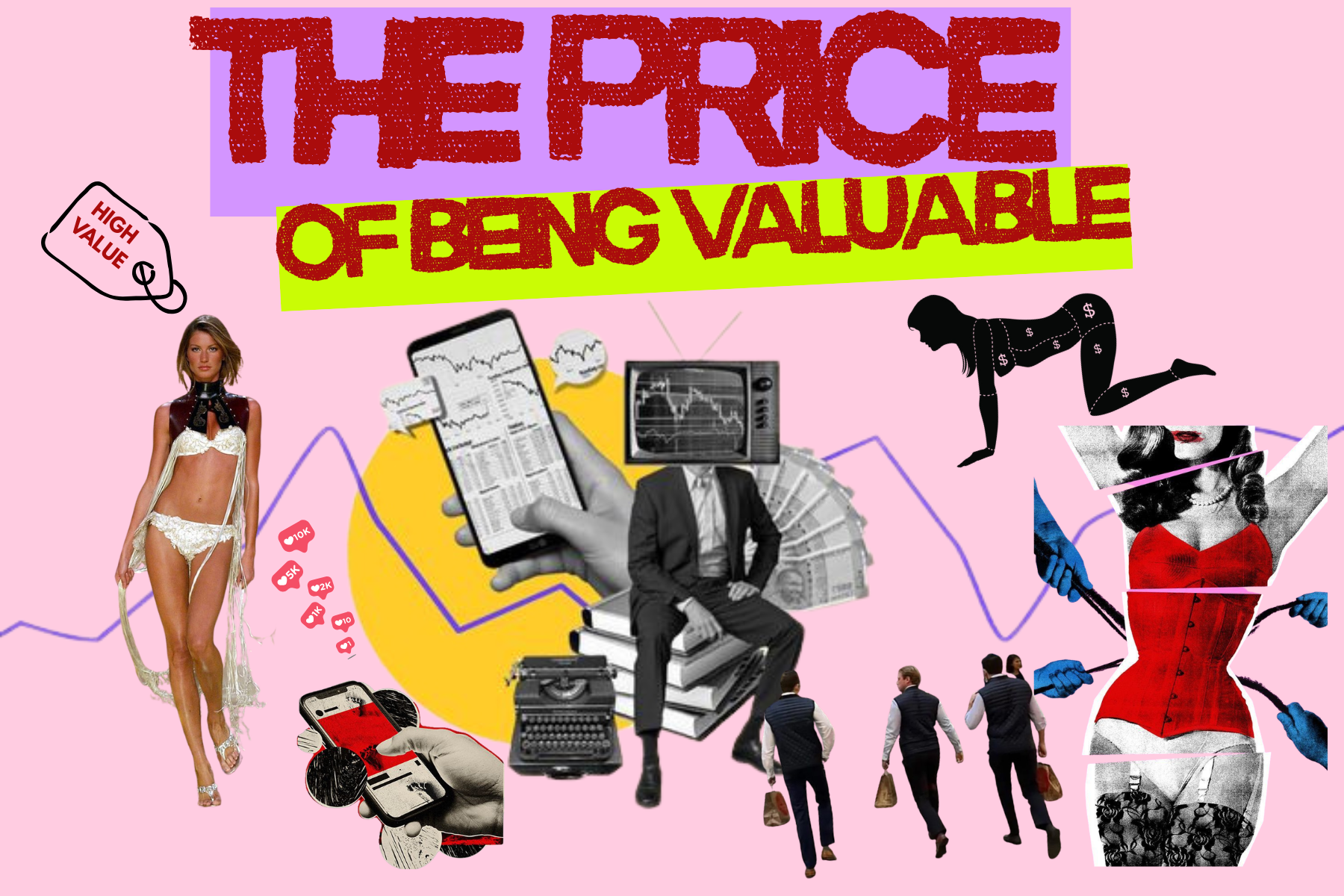

THE THIN LINE BETWEEN APPRAISAL AND EMPOWERMENT
There was a time when being “valued” sounded like something you wanted from your boss, your partner, or perhaps a particularly attentive maître d’. Now? It sounds suspiciously like a performance review with better lighting. Somewhere between the rise of the “high-value woman,” the “provider man,” the algorithmic face tune-up, and the soft tyranny of a front-facing camera, we’ve turned value into a social currency, visible, measurable and definitely marketable. We don’t just have worth anymore. We brand it. When did being valued stop meaning being cherished and start meaning being ranked?
In modern society, value has become dangerously seductive. It sounds empowering, sound being the operative word. But beneath the glamour is a far less fabulous question: are we talking about dignity or desirability? More importantly, who exactly is doing the valuing? Once upon a time, value was a moral word. You were valuable because of your characteristics, the small identifiers to showcase if you were a good human, to showcase if you were valuable. Now, on social media, value is often aesthetic first, emotional second, and human somewhere near the bottom.
The internet, of course, has become one long digital mirror, and unfortunately, it’s often a funhouse one. Research has repeatedly shown that appearance-based comparisons on platforms like Instagram are tied to lower body-esteem and lower self-esteem, particularly when users engage in upward comparisons, constantly measuring themselves against people who appear more attractive and polished and therefore more valuable. A 2024 study in Discover Psychology found that upward comparisons on Instagram significantly decreased body esteem, while a 2023 study in BMC Psychology linked photo-editing behaviour to self-objectification, appearance comparison, and lower self-esteem. In other words, the more we tweak the image, the more the image starts tweaking us. That’s the quiet trick of modern “value culture”: it convinces us that self-worth is something you can optimise. Not cultivate and certainly not inherit by virtue of being gloriously, inconveniently human.
And isn’t that the saddest little luxury of all? There’s an app for your skin, a filter for your jawline, a trend for your body, a phrase for your relationship marketability, and apparently, a tutorial for becoming “high value” in under ninety seconds. How efficient. But let’s not pretend this conversation lands equally on everyone. Women, especially, have always been appraised before they were understood. Society has long had a knack for mistaking a woman’s appearance for her essence. The packaging has changed, corsets out, contour in, but the premise remains eerily familiar: be beautiful, but not vain; be desirable, but not too available; be accomplished, but never threatening.
Today, the language is slicker. We call it standards, femininity, soft life, luxury energy, and knowing your worth. And to be clear, knowing your worth is not the problem. The problem is when “worth” becomes a euphemism for compliance with a market-tested beauty and behaviour script. A 2023 review in Nature Reviews Psychology describes sexual objectification as a cultural system that prioritises women’s appearance and sexual appeal over their other attributes, noting that it remains widespread and deeply consequential. Social media did not invent objectification; it simply gave it ring lights, affiliate links, and a saveable audio clip. Even fashion media is beginning to push back. Vogue recently highlighted Aerie’s anti-AI, anti-retouching stance, explicitly framing the rise of artificial bodies and manipulated imagery as a mental-health and authenticity issue. It’s telling that in 2026, not altering a body in a campaign is treated as radical. As if pores have become political. Which of course leads us to the age-old issue of women’s bodies and the pedantic and incessant topic of policing every minor detail of women in order to destabilise them and take away their power by directing their energy into things that don’t truly matter.
And yet, women are often told that learning the rules of this game is empowerment. Dress well, curate yourself well and then date strategically. It’s all one big fantasy, until you realise that if your value depends on perpetual self-surveillance, it isn’t empowerment, but simply maintenance. That same performance pressure, of course, hasn’t spared men either. It has simply dressed them in different languages. If women are sold the fantasy of being “high value,” men are increasingly sold the burden of having to prove it. Online, masculine value is often packaged as income, status, stoicism, muscle, dominance, provider energy, and the idea that masculinity itself must be continuously demonstrated, preferably in a monochrome gym mirror. It’s the same disease in a different suit.
Men, too, are being taught to confuse human worth with market metrics: how much they earn, how many women want them, how disciplined they appear, how emotionally invulnerable they can remain while discussing protein intake and quarterly goals. The irony is that everyone loses. Women become products. Men become portfolios. And intimacy becomes a negotiation between two personal brands. Even research beyond beauty points to how gendered our ideas of visibility and self-promotion remain. One large-scale study on scholarly self-promotion found that women were substantially less likely than men to self-promote on social media, and when they did, the returns were lower. Even in supposedly meritocratic digital spaces, the same behaviour doesn’t mean the same thing depending on who’s doing it. So when we talk about “being valued,” we have to ask: valued according to whose rules, and at what emotional cost?
The algorithm, naturally, has taste; unfortunately, it’s often basic. Social media doesn’t merely reflect culture; it amplifies its least examined instincts. Platforms reward what’s clickable, covetable, and instantly legible. A 2024 Pew Research Centre report found that nearly half of U.S. teens say they’re online almost constantly. In a world where the feed is continuous, comparison becomes ambient, no longer an occasional bad habit, but a background condition of modern life. That’s how you end up staring at a stranger’s holiday carousel and wondering whether your own life has somehow failed because you don’t go on as many holidays.
This is where the phrase “high value” becomes especially slippery. It borrows the language of self-respect but often functions like marketplace logic: scarcity, demand, access, competition, perceived premium. In personhood, this logic is catastrophic, because people are not luxury goods. And if someone has to “qualify” for basic respect, we’re not discussing standards. We’re discussing hierarchy. So, is being called “high value” a compliment? Sometimes, but only if we’re very careful. If by “high value” someone means emotionally mature, self-respecting, discerning, kind without being porous, ambitious without being hollow, stylish without being enslaved by style, and deeply rooted in self-definition rather than public approval, then yes, it can be shorthand for an admirable presence. But the term itself remains problematic because it carries an economic frame. It suggests people exist on a scale, which, in turn, invites ranking. It implies scarcity, competition, and transactional worth. And if there’s one thing women especially have had enough of, it’s being treated like stock.
There is a world of difference between saying “I value myself” and saying “I am valuable because others perceive me as high value.” One liberates, whilst the other performs, and perhaps that’s why Sex and the City still feels so strangely relevant here. If Carrie Bradshaw taught us anything, apart from the necessity of a good pair of Manolos and a bad decision, it’s that women have always been asked to make philosophy out of desire.
Carrie still resonates because she was never polished to perfection. Vogue recently noted that a new generation sees her not as aspirational in the traditional sense, but as gloriously flawed and emotionally transparent. In an era that has become so over-curated it borders on sterile, her messiness now reads as authenticity. And that matters, because the modern digital self is so aggressively edited that imperfection now feels almost rebellious. To be a little wrinkled, a little unsure and a little too earnest in 2026, that may be the most radical luxury of all. Carrie, for all her chaos, was never “high value” in the internet sense (and to Mr Bigs in the early seasons, unfortunately). She was inconsistent, occasionally delusional, often overinvested, and deeply committed to asking questions in heels.
Maybe that’s the standard we’ve been missing. Not high value but high vitality. Not “How desirable am I?” but “How deeply do I inhabit my own life?” Real value is not always glamorous. It rarely trends. It doesn’t always fit into the status quo captionable morning rituals or the suspiciously tidy emotional architecture of people who claim they’ve mastered feminine energy before 8 a.m. Real value looks far less photogenic than we’ve been taught. It’s discernment without cruelty.
It looks like being able to leave the room where you are admired but not respected. It looks like not shrinking your intellect to preserve someone else’s comfort. It looks like refusing to mistake desirability for destiny. It looks like understanding that being chosen is not the same as being known. And for men, too, real value looks less like domination and more like depth: emotional literacy, steadiness, integrity, humour, generosity, accountability, the kind of traits that won’t necessarily go viral, but do make for better human beings.
So, is “you’ve been valued” empowering? Only when it means you have been seen in full, respected in truth, and treated with dignity. Not when it means you photographed well, conformed beautifully, performed desirably on schedule, or passed a cultural stress test. The modern danger is not that we want to feel special; it’s that we’ve let too many external systems define why. Social media can be connective, but for the most part, it can also be a comparison casino where everyone loses except the house.
Reference List
Taylor, J., & Armes, G. (2024). Social comparison on Instagram, and its relationship with self-esteem and body-esteem. Discover Psychology, 4, Article 126.
Ozimek, P., Lainas, S., Bierhoff, H.-W., et al. (2023). How photo editing on social media shapes self-perceived attractiveness and self-esteem via self-objectification and comparisons of physical appearance. BMC Psychology, 11, Article 99.
Ward, L. M., Daniels, E. A., Zurbriggen, E. L., et al. (2023). The sources and consequences of sexual objectification. Nature Reviews Psychology, 2, 496–513.
Pew Research Centre. (2024). Teens, Social Media and Technology 2024.
Peng, H., Teplitskiy, M., Romero, D. M., & Horvát, E.-Á. (2022). The Gender Gap in Scholarly Self-Promotion on Social Media. arXiv preprint.
Vogue. (2026). Aerie Takes a Stand Against AI Marketing With Pamela Anderson.
Vogue. (2025). ‘She’s So Real for That’: What Does Gen Z See in Carrie Bradshaw?
Vogue. (2025). Are We All Actually Bloated?
Psychology Today UK. (2025). Social Media Builds and Breaks Self-Esteem.



Leave a Reply