
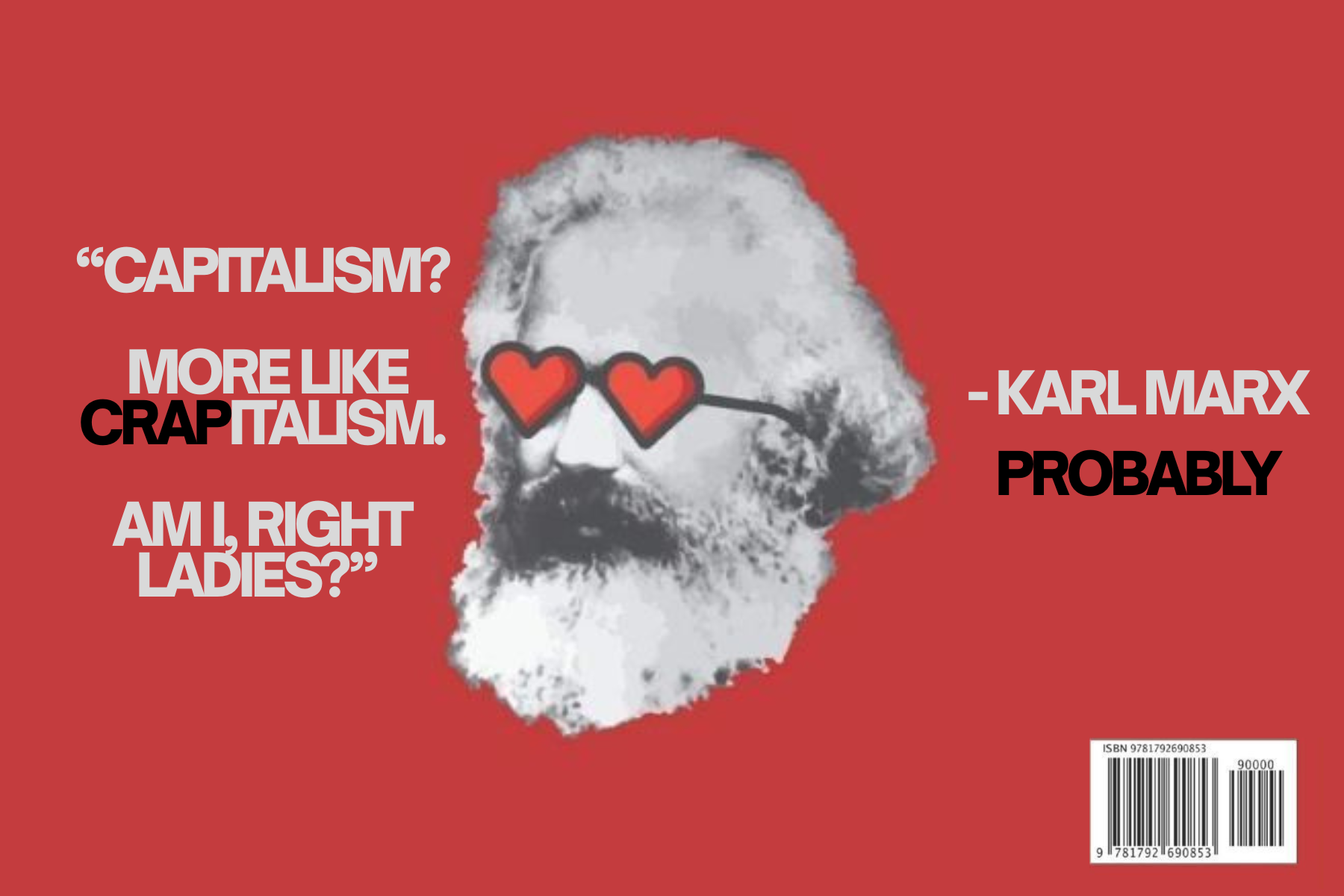

IS MONOGAMY A TIMELESS ROMANTIC IDEAL – OR THE MOST PROFITABLE LUXURY REBRAND CAPITALISM EVER PULLED?
There are few stories modern culture tells with more conviction than this one: somewhere out there, amid the situationships, the astrological incompatibilities, the soft-launches, the ghosting, and the men who describe emotional unavailability as “protecting my peace,” there is one person who is meant for you, your soulmate. It’s a comforting idea, really, equal parts Plato, Pinterest, and panic.
And yet, like all irresistible myths, it becomes even more interesting the moment you ask the least romantic question possible: who benefits?
Because once you begin looking at monogamy, and its shimmering couture cousin, the soulmate myth, through the lens of capitalism, the whole thing starts to look less like eternal truth and more like the most successful social packaging imaginable. Not false, necessarily, but very useful to markets and our economy. The soulmate is, after all, a remarkably efficient concept. One person, one great love, one sanctioned emotional destination. It is desire simplified into a neat and sellable narrative, like romance with a supply chain.
Before the traditionalists clutch their pearls and the polycules start, let’s be grown-ups about this. Monogamy itself is not the enemy. Plenty of people genuinely want it, choose it, thrive in it, and build beautiful, ethical, emotionally intelligent lives inside it. The problem is not that monogamy exists. The problem is that it has been culturally installed as the premium default, not simply one valid relationship structure among many, but the polished, aspirational, morally legible endgame. It is presented not as preference, but as proof. When you enter the period where you start thinking about ‘settling down’, that’s the proof that you’re now serious and mature. Proof that love has become official enough to be monetised, photographed, and eventually discussed in relation to property and marital contract, how romantic.
And if that sounds cynical, forgive me, but the wedding industry alone would like a word, a word worth a billion dollar industry.
For something supposedly rooted in nature, destiny, and sacred intimacy, modern monogamous romance comes with an extraordinary amount of administrative infrastructure. There are engagement rings priced according to a marketing campaign that convinced generations of people that emotional sincerity could, and should, be measured in carats. There are bridal “seasons,” bachelorette itineraries, registry algorithms, couples’ therapy apps, anniversary experiences, matching luggage, “his and hers” skincare, honeymoon suites, fertility packages, family cars, and homes staged so perfectly for two that a single woman in a beautifully decorated flat still reads, to some people, like an unresolved plot point. Even heartbreak is a consumer category now, scented candles, solo travel retreats, post-breakup Pilates, revenge dressing, healing journals in muted blush tones. Capitalism has never met a feeling it couldn’t merchandise.
Which is precisely what sociologist Eva Illouz spent years articulating with far more academic precision. Her work on romance and consumer culture remains foundational because it refuses the comforting lie that love somehow exists outside the market, untouched by commerce and pure in its own candlelit corner. Modern romance, she argues, was not merely expressed through consumer culture; it was profoundly shaped by it. Leisure, fantasy, desire, self-making and aspiration all became entangled with the experience of romantic life. Dating itself became a performance staged through consumable environments. Love became a script, and the market provided the props. The dinner reservation, the weekend away, the bouquet, the ring and then ultimately the wedding. None of these is inherently hollow, but neither are they neutral. They help tell us what love is supposed to look like, and more importantly, what it is supposed to cost.
If capitalism has a signature move, it is this: take something ancient and unruly, give it a narrative, attach scarcity, then sell the solution back to us with better lighting and a catchy slogan.
The soulmate myth may be its most sophisticated case study. Because what is a soulmate, really, if not scarcity dressed as transcendence? One person. One rare and irreplaceable match in a world of billions. It is emotionally intoxicating because it transforms ordinary longing into cosmic significance. But it is also structurally convenient. If there is only one true love, then desire becomes a hunt. Choice becomes high-stakes, and the pressure to secure, preserve, and display the relationship intensifies accordingly. You are not just dating; you are locating your destiny in a market saturated with options. You are not just in love; you are winning.
The language of romance in late modern life has become eerily adjacent to the language of acquisition. We “find” someone, then “lock it down” and we absolutely have to “invest” in the relationship. Dating apps, with all the tenderness of an airport vending machine, only there for convenience and the occasional late-night pick-me-up, intensify this logic by turning attraction into interface and abundance into stress. Swipe left, swipe right, compare, assess, shortlist, discard. The modern romantic subject is expected to remain open, intuitive, and self-actualised, and somehow not deeply unwell while navigating a system that often feels like a gamified stock exchange for attachment styles. In that context, the soulmate fantasy becomes not merely romantic but reparative. If everything feels replaceable, then the dream of the irreplaceable becomes almost unbearably seductive. And that, perhaps, is the real twist. The soulmate myth is not simply a capitalist fabrication. It is also a human coping mechanism in a late-stage capitalist age.
We want to be singular because the world keeps teaching us how easily we can be rendered generic. We want to be chosen in a culture obsessed with optimisation and want to believe there is someone for whom we are not just an option, a phase, a lesson, but a certainty. The soulmate offers a fantasy of being exempt from the churn. That fantasy may be culturally engineered, yes, but it also answers a very real emotional hunger. Which is why dismissing it outright always feels intellectually neat and spiritually cheap. People do not cling to these myths because they are stupid. They cling to them because modern life is destabilising, and certainty, especially romantic certainty, is one of the few delusions that still feels glamorous. And perhaps the most romantic side of all of this is two incomes. Because let’s face it, one income and a side hustle just isn’t enough now.
Of course, monogamy’s relationship to capitalism is not merely aesthetic, but also institutional. Historically, scholars from Friedrich Engels onward have pointed out that dominant family structures are rarely just about love. They are about property, inheritance, lineage, labour, and social order. The nuclear household, two adults, one domestic unit, children if applicable, resources pooled and privately managed, has long functioned as a deeply useful economic arrangement. It stabilises care work and organises dependency. It makes households into consumption engines and, crucially, into units legible to the state. Taxes, mortgages, insurance, inheritance, health benefits, school forms, immigration status – modern life is still astonishingly eager to reward the couple.
Even now, being partnered often grants a kind of social legitimacy that singlehood is still denied. A woman dining alone in a perfect coat is aspirational in editorial photography and faintly tragic in the cultural imagination. A man who remains unpartnered deep into adulthood can still be treated as either suspiciously unserious or tragically unfinished. And for all our contemporary rhetoric about freedom and self-definition, we continue to organise adulthood around coupledom with startling persistence. Just like the eternal “don’t worry, you’ll meet someone” to a single woman in her thirties, offered as both a blessing and a threat.
This is where the discourse often gets unserious, because the internet cannot resist turning every intimate preference into ideology. In some corners, monogamy is framed as bourgeois, patriarchal, regressive, emotionally timid – a relationship model for the spiritually conventional and the tax-efficient. In others, any critique of monogamy is treated as a covert attack on commitment itself, as though asking whether a structure is socially conditioned is equivalent to burning down someone’s wedding venue. Meanwhile, non-monogamy gets alternately fetishised as radical and dismissed as narcissism with a reading list. Everyone is performing enlightenment; very few are admitting confusion.
Anthropology, sociology, and evolutionary psychology all complicate the tidy story that monogamy is simply “natural.” Human beings, maddeningly, do not organise themselves in one universally consistent way. Across cultures and historical periods, we find variation: monogamy, polygyny, informal plural arrangements, serial monogamy, tolerated infidelity, communal childrearing, legal fictions, quiet hypocrisies, elaborate moral codes that collapse on contact with actual desire. Even in societies that formally idealise monogamy, practice has always been messier than the doctrine. Which is not an argument against monogamy so much as a reminder that what we call “natural” is often just “currently dominant and narratively convenient.”
That distinction matters because once we stop treating monogamy as a biological inevitability, we can begin to treat it as what it actually is: a structure. Sometimes liberating precisely because it is chosen freely. Sometimes deadening because it is not.
The same is true of the soulmate. We should be suspicious of it, but not because poetry is embarrassing. The soulmate myth is powerful because it turns compatibility into cosmology. It doesn’t just ask whether someone fits your life; it asks whether they were written into it. That is catnip for creatures as narratively vain as we are. We do not simply want affection. We want symbolism, we want to feel that our desire means something beyond itself. We want love to arrive not as a practical agreement between two imperfect adults with unresolved childhood wounds and decent taste in lamps, but as a revelation.
And perhaps that is why even the most cynical among us keep a tiny private altar for romance. We mock destiny and still secretly want to be ambushed by it. We roll our eyes at “when you know, you know” and of course speak in the language of boundaries, compatibility metrics, and emotional literacy, all of which are very useful, while quietly craving the older, more irrational experience of recognition. Capitalism did not invent that feeling. But it absolutely knows how to monetise the atmosphere around it.
That is the nuance the loudest cultural takes tend to flatten. To say monogamy has been shaped by capitalism is not to say every monogamous relationship is a scam. To say soulmates are culturally manufactured is not to deny that profound recognition exists. It means only that our deepest desires are never untouched by the systems we live inside. We inherit scripts long before we know we are performing them. The question is not whether our love has been influenced, because it of course has, but whether we are conscious enough to distinguish desire from design.
Do you want exclusivity because it genuinely nourishes you, or because you have been taught it is the only form of love that counts? Do we want one partner because it expands our life, or because social legitimacy is easier to secure when our intimacy fits the template?
That may be why the soulmate remains such a stubborn cultural obsession. Not because we literally believe there is one predestined person assigned to each of us by the celestial HR department, but because the language of soulmates gestures toward something we have not yet found better words for.
And perhaps that is where monogamy, at its best, can still be rescued from its own marketing. Not as a compulsory milestone and not as evidence that one has “won” at adulthood. But as one possible container for intimacy among many.
So, to conclude, no, I don’t think monogamy is merely a capitalist structure, and I don’t think soulmates are merely propaganda, but that does not mean that they are innocent. They are real in the way all powerful myths are real: not because they are universally true, but because they shape behaviour, organise desire, and quietly determine what kinds of lives are considered intelligible.
And if that sounds bleak, I prefer to think of it as clarifying. Once you see the script, you can decide whether to perform it, rewrite it, or improvise something messier and more alive. You can choose one person because you genuinely want the architecture of a shared life, not because exclusivity flatters your fear. You can reject the soulmate myth while still allowing yourself the thrill of improbable recognition. You can refuse the marketplace’s version of romance without becoming emotionally minimalist about your own heart.
To love someone, or several someones, or no one at all – it’s your life, do what you want with it – without outsourcing your worth to the structure itself. To understand that there is nothing especially revolutionary about being monogamous, and nothing especially enlightened about not being. The radical thing, if we insist on that word, is consciousness.
So perhaps the question is not whether monogamy is capitalist or whether soulmates are real. Perhaps the better question is this: when you strip away the branding, the market logic, the inherited respectability politics, and the expensive white flowers, what remains of love that is actually yours?
REFERENCES
Eva Illouz, Consuming the Romantic Utopia: Love and the Cultural Contradictions of Capitalism (Berkeley: University of California Press, 1997). This is the key academic foundation for understanding how romance, leisure, fantasy, and consumer culture became deeply entangled in modern capitalist life.
Eva Illouz, Why Love Hurts: A Sociological Explanation (Polity, 2012). Particularly useful for understanding modern romantic suffering through structures of choice, individualism, and emotional capitalism.
Friedrich Engels, The Origin of the Family, Private Property and the State (1884). A classic, if debated, theoretical text for thinking about family structure, property, and the institutional usefulness of particular forms of pair-bonding.
Ning Cai, Chen Diao, Bo-Han Yan, and Jin-Hu Liu, “Social Computing Based Analysis on Monogamous Marriage Puzzle of Human,” arXiv (2017). Useful as a broad overview of arguments around the emergence and social function of monogamous marriage systems.
Anthony Giddens, The Transformation of Intimacy: Sexuality, Love and Eroticism in Modern Societies (Stanford University Press, 1992). Important for framing modern relationships as increasingly reflexive, negotiated, and identity-forming.
Zygmunt Bauman, Liquid Love: On the Frailty of Human Bonds (Polity, 2003). Essential for the language of instability, disposability, and uncertainty in contemporary intimacy.
bell hooks, All About Love: New Visions (William Morrow, 2000). Not specifically about capitalism and monogamy as a system, but invaluable for distinguishing love as ethical practice from love as fantasy or possession.
Esther Perel, Mating in Captivity (Harper, 2006). Useful for the tension between security and desire within long-term monogamous structures, especially in contemporary culture.
Contemporary cultural texture and discourse can be usefully triangulated through longform essays and fashion-culture commentary in magazines such as Dazed, i-D, The Cut, New York Magazine, Vogue, and Byline Byline, particularly recent essays on relationship politics, selfhood, dating-app fatigue, and the aesthetics of intimacy.


Leave a Reply