
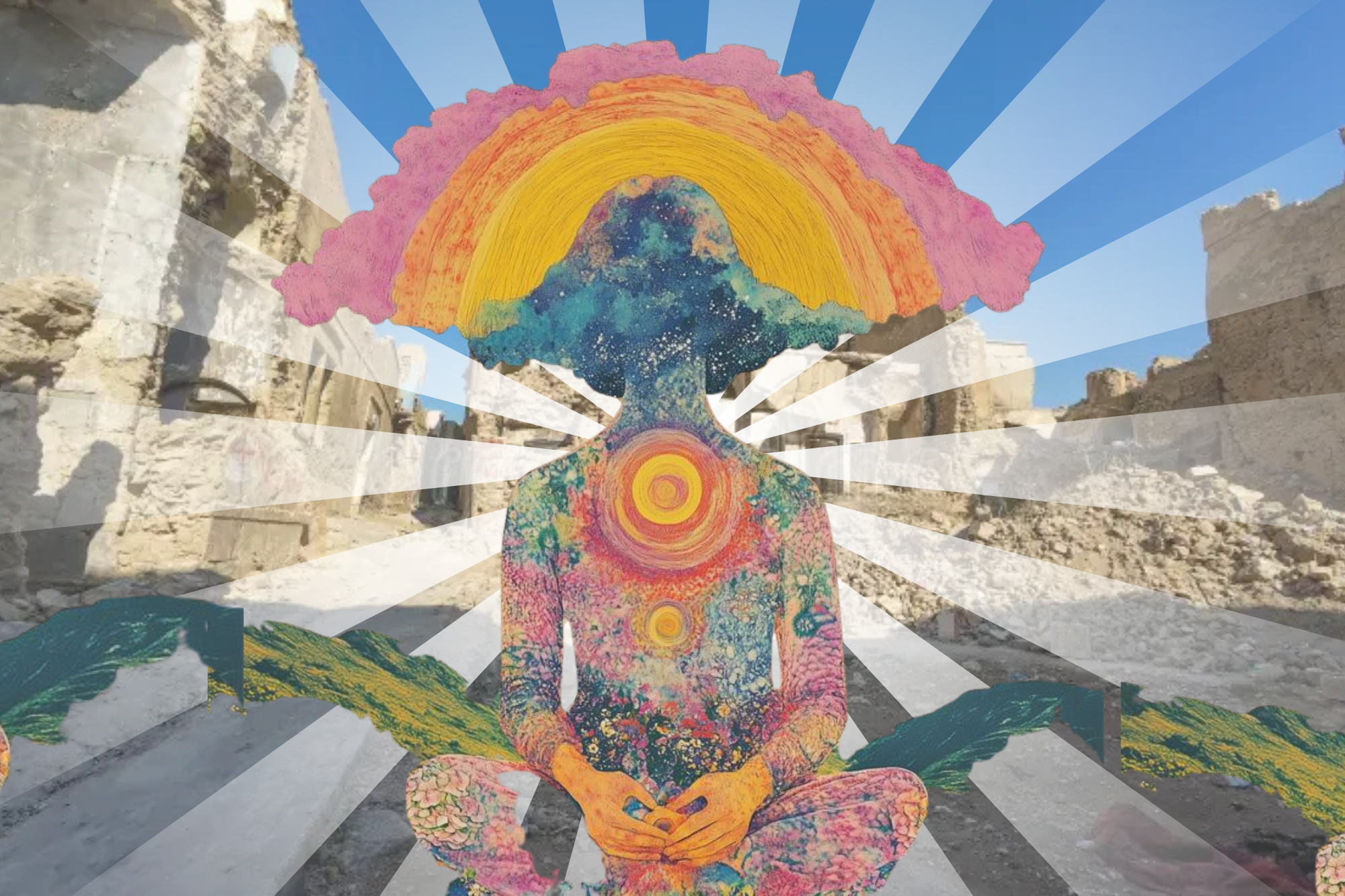

IN AN AGE OF PERMANENT CRISIS, IGNORANCE HAS BECOME LESS A FAILURE OF INTELLECT THAN A SURVIVAL STRATEGY. THE REAL QUESTION IS WHETHER THAT STRATEGY IS KEEPING US SANE OR KEEPING US COMPLIANT.
The news cycle convulses and moves at speed. It arrives not as information but as impact. A bombardment of war footage, political grotesquery, ecological breakdown and algorithmically optimised dread, delivered in a format designed to be consumed between meetings, in bed, or while waiting for a train. As I’ve said before, and believe me, I am still decisively an optimist despite what I’m about to say, our levels of unprecedented social mobility may be a massive step in technological and cultural advancement; however, politically, it has been weaponised and used to our disadvantage. One atrocity eclipses another before the first has been metabolised. A city floods, a government slides further into authoritarian theatre, another hospital is reduced to rubble, and before the emotional residue has even settled, the feed refreshes and asks for your attention again. We are living through an age in which catastrophe is not an interruption to normal life but one of its principal aesthetics.
It is hardly surprising, then, that so many people have developed the habit of looking away. Not always dramatically, and not always with the kind of moral vacancy critics like to diagnose from a distance. More often, it happens in smaller gestures: the article not opened, the footage skipped, the headline read and instantly buried beneath celebrity trivia, the phrase “I just can’t deal with this right now” deployed not as an excuse but as a nervous system speaking in plain English. There is a tendency, particularly among the professionally indignant, to frame such behaviour as weakness. But that misses the point. For many people, ignorance is no longer simply a deficit. It is a coping mechanism.
Psychology has a term for this: deliberate ignorance. It describes the conscious choice not to seek out or engage with information one expects to be distressing, destabilising, or otherwise costly. Far from being an irrational quirk, researchers argue it often serves recognisable functions: emotional regulation, conflict avoidance, preservation of hope, and protection from helplessness. In other words, people do not always avoid bad news out of foolishness. They avoid it because they are trying to remain functional in conditions that are, by any reasonable measure, psychologically unsustainable. The modern citizen is not merely under-informed. They often self-censor what their minds can bear.
There is, however, a danger in romanticising this too quickly. Because the same mechanism that shields a person from collapse can also leave them exquisitely vulnerable to manipulation. When the world becomes too much to process, one response is apathy, another is conspiracy. Both offer escape from the intolerable burden of complexity. Conspiracy theories are seductive precisely because they transform chaos into plot. They insist there is a script and a hidden author. They offer certainty to people who feel politically homeless. Apathy offers a different consolation. It is less dramatic but no less consequential.
Neither response emerges in a vacuum. Both are downstream of a broader political condition in which trust has been systematically hollowed out. Institutions once sold as stabilising forces now appear, to many, either captured, complicit or simply incompetent. Governments fail visibly. Media ecosystems reward velocity over verification. Corporations market ethics while underwriting destruction. Citizens are told to remain informed while submerged in a torrent of contradictions, propaganda, spectacle, and monetised despair. Under such conditions, disengagement begins to look less like a personal moral flaw and more like a predictable social outcome.
This is where the conversation has to become political, because ignorance has never been merely private. Societies have always depended on forms of organised not-knowing. Sometimes that has meant literal censorship. More often, it has meant managing the terms under which reality is perceived. Empire requires distance. Exploitation requires abstraction. If the human cost of policy can be rendered statistical, if environmental devastation can be diluted into quarterly reports, if state violence can be dressed in euphemism and broadcast between adverts, then public outrage becomes easier to diffuse. The old authoritarian model restricted access to information. The contemporary model often does the reverse. It floods the zone until discernment itself becomes exhausting.
This is the real bait-and-switch of the digital era. We were promised transparency and handed saturation. We were told that connectivity would produce democratic clarity, and instead we inherited a marketplace of curated realities in which every worldview can be algorithmically tailored to taste. We no longer inhabit a shared public sphere so much as adjacent emotional ecosystems. Some people live inside a permanent emergency broadcast. Others live inside a mood board. Both can scroll past the same event and come away with entirely different understandings of whether it matters, whether it happened, or whether it is even real. Under these conditions, ignorance is not merely the absence of knowledge. It is an infrastructure.
And yet awareness, for all its moral prestige, is no simple remedy. There is a fashionable tendency to treat awareness as an uncomplicated virtue, as though being highly informed were synonymous with being politically effective or ethically serious. It is not. Awareness can be clarifying, but it can also be corrosive. To be deeply informed about ecological collapse, democratic erosion, war, misogyny, racial violence and economic precarity is not merely to know facts. It is to expose yourself repeatedly to evidence that the systems governing collective life are capable of extraordinary harm and often insulated from meaningful accountability. Unsurprisingly, that has consequences.
The mental health literature on climate distress, in particular, has made this plain. Terms such as eco-anxiety, climate grief and environmental despair are not the indulgent language of a fragile generation; they are attempts to describe a rational emotional response to a destabilising reality. The American Psychological Association has repeatedly documented the psychological burden associated with climate-related stress, especially among younger people who are acutely aware of the scale of the crisis and acutely doubtful that institutions will respond with the urgency required. Political awareness can produce a similar burnout: a sense of being permanently activated but structurally powerless, morally alert but practically cornered. In that context, awareness ceases to feel like enlightenment and starts to resemble exposure injury.
But if ignorance can shade into complicity, awareness can curdle into paralysis. The question, then, is not whether to know or not know. It is how to remain in contact with reality without allowing reality, as mediated by platforms built to monetise panic, to colonise your interior life. The distinction matters. There is a profound difference between being informed and being flooded. Between bearing witness and becoming emotionally incapacitated. Between understanding the world and consuming its worst moments as an endless theatre of collapse.
This is where the idea of selective engagement becomes useful. Research on deliberate ignorance does not suggest that people always reject the truth wholesale. More often, they are modulating contact with it. They are limiting exposure to information they cannot act on, while preserving room for knowledge that is actionable, contextual or necessary. This is not the same as denial. It is closer to psychological reasoning. If one spends three hours spiralling through footage of destruction on a platform engineered to keep them dissociated, that is not political consciousness. It is nervous-system attrition. If, instead, one seeks reliable reporting, understands the stakes, supports material interventions, joins local organising, donates, votes, writes, resists, then awareness has been converted into agency rather than left to rot as spectacle.
This matters because there is now a profitable confusion between attention and action. We have been encouraged to believe that witnessing is, in itself, a sufficient moral performance. It is not. Nor is permanent emotional devastation evidence of seriousness. The contemporary culture of crisis often mistakes exhaustion for virtue. It flatters people into believing that if they are burnt out enough, anguished enough, permanently online enough, they are somehow closer to justice. But a politics of endless psychic depletion is politically useless. It produces spectators who are emotionally saturated and strategically inert.
What actually sustains resistance is rarely glamorous. It is not the ecstatic drama of outrage but the quieter architecture of durable attention. It is the person who learns how local policy works. The neighbour who volunteers at a food bank. The tenant who turns up to a housing meeting. The donor who gives regularly to frontline aid. The organiser who keeps showing up after the cameras have moved on. The journalist who insists on context when the culture demands reaction. The citizen who refuses the anaesthetic of irony. These acts do not trend because they are not designed to. But they are what prevent awareness from collapsing into voyeurism.
There is also, unavoidably, a deeper question beneath all this, one that moves beyond politics into something closer to philosophy, or metaphysics. Why does looking away feel so costly, even when it feels necessary? Part of the answer is moral. To know about suffering and remain untouched by it is, at some level, a diminishment. But part of the answer may be stranger than that. Ancient traditions have long insisted that the separation between self and world is less stable than modern life encourages us to believe. The Sanskrit phrase Tat Tvam Asi — “Thou art That” — from the Chandogya Upanishad gestures toward an unsettling intimacy between the observer and the observed: that the world is not merely something outside us, but something in which we are implicated. If taken seriously, even metaphorically, it makes ignorance feel less like neutrality and more like withdrawal from participation in reality itself.
That does not mean one is obliged to become omniscient, permanently activated, or emotionally available to every global tragedy at all times. Such a demand would be absurd and, frankly, politically illiterate. No one can sustain that level of exposure without damage. But it does mean that attention has ethical weight. What we repeatedly refuse to see shapes us. What we repeatedly choose to witness shapes us too. The habits of looking away are never just about comfort; they are about what kind of person, and what kind of public, we are becoming.
There is a line often attributed to Alan Watts — that “the only way to make sense out of change is to plunge into it, move with it, and join the dance.” It risks sounding trite in the age of inspirational quote graphics, but stripped of lifestyle branding, it captures something severe and useful. Reality is not waiting for us to feel ready. History is not pausing while we regulate. The point is not to become numb enough to survive or pure enough to suffer elegantly. The point is to cultivate a form of consciousness that can withstand contact with the world without surrendering either discernment or tenderness.
That is harder than ignorance and less theatrical than despair. It requires a kind of disciplined attention: not endless consumption, but lucid contact; not maximal exposure, but chosen responsibility; not passive awareness, but forms of engagement that can actually be lived. In an age where both panic and passivity are profitable, this may be the closest thing we have to resistance.
So yes, ignorance can feel like safety. Sometimes it is safety. Sometimes it is the psychic curtain we draw because the storm is too loud and the walls are too thin. But there is a fine line between protecting the self and evacuating the world. One preserves the capacity to act. The other quietly erodes it. That is the distinction that matters.
The question, finally, is not whether we can know everything. We cannot. The question is whether we can learn to know enough — enough to stay human, and enough to refuse the temptation of curated helplessness. In a culture built on distraction, that may be the most subversive form of attention left.
REFERENCES
- Hertwig, R., & Engel, C. (2016). Homo Ignorans: Deliberately Choosing Not to Know.Perspectives on Psychological Science, 11(3), 359–372. DOI: 10.1177/1745691616635594. Verified via PubMed.
- Social Science Research Council / MediaWell citation entry for Hertwig & Engel’s Homo Ignorans (2016), summarising deliberate ignorance as the conscious choice not to seek or use knowledge.
- American Psychological Association resources on climate change and mental health, including climate distress / eco-anxiety framing.
- Tat tvam asi entry, Encyclopaedia Britannica, noting the phrase appears in the sixth chapter of the Chandogya Upanishad (c. 600 BCE).
- Alan Watts, The Wisdom of Insecurity (1951), source commonly associated with the quote: “The only way to make sense out of change is to plunge into it, move with it, and join the dance.” Verified via quotation archives.



Leave a Reply